
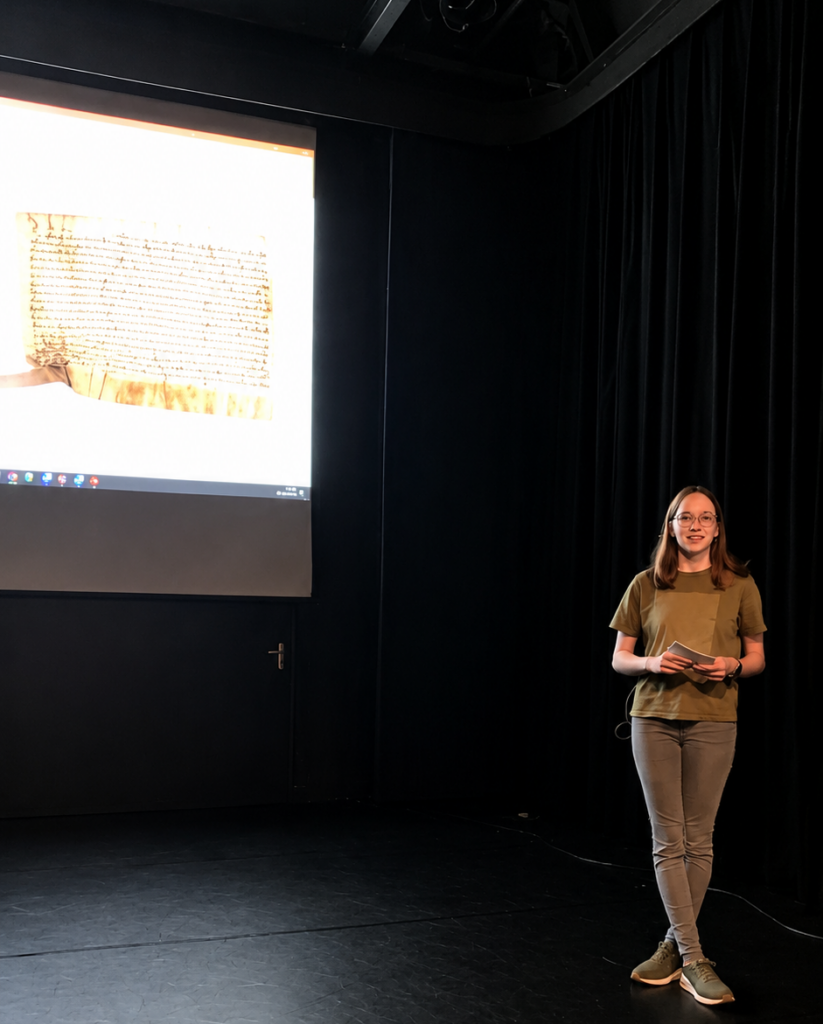
Thursday 11 June 2026, Marco in ‘t Veld and Wenneke Bos held a lecture for the Historische Vereniging Schoonhoven about medieval toll- and staple rights. In this presentation they argued that the medieval staple rights of Dordrecht (established in 1299) were a next step on the escalation latter of toll enforcement. As toll collectors were not allowed to inspect ships of toll exempt people, staple rights would have strengthened the position of the toll collector. Initially the enforcement capacity of the newly established staple rights was directed towards the Flemish (with whom the count of Holland was at war).
As of 1320/1321, citizens of Schoonhoven were first held to the staple rights. The small city protested vehemently but had to convince a count of Holland who had heavily invested in his collaboration with Dordrecht. In order to do so, Schoonhoven defended itself by a twofold appeal to customary law. First, the staple rights of Dordrecht had not been enforced against Schoonhoven for more than twenty years. Second, toll exemption had always meant ‘no inspection’ by the toll collector and therefore also ‘no staple rights’. With these strong arguments, the count could not escape having to judge in favour of Schoonhoven. This verdict, however, seemed a Pyrrhus victory for Schoonhoven, as the staple rights were slowly re-instituted in the 1330s.
In the fifteenth and sixteenth centuries, the arguments of Schoonhoven against the staple rights of Dordrecht became more diversified. It used a wide array of legal, economic, and historical arguments against Dordrecht, including the argument that Count Willem V showed signs of insanity while re-instating certain staple rights in 1355! The city of Schoonhoven also invoked the Roman Law concept of the free river, as well as the argument that they were economically abused by Dordrecht. Despite these arguments, Schoonhoven seems to have focused mainly on excessive enforcement from the side of Dordrecht, while implicitly accepting the existence of the staple. This story reveals how close collaboration between the count of Holland and the city of Dordrecht in this period effectively neutralised the legitimate protests of Schoonhoven in the long run.

dr. Marco in ‘t Veld
Co-author

Wenneke Bos
Co-author