
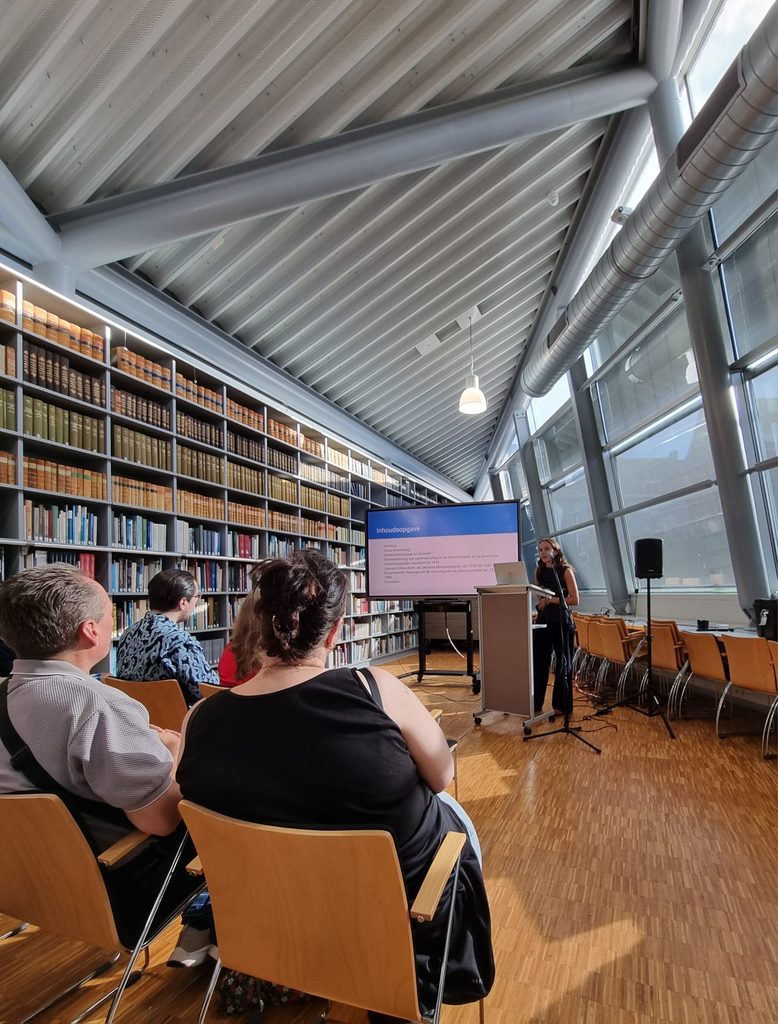
As conclusion of her research fellowship at the Zeeland Archives (Zeeuws Archief), Valérie Slijkerman gave a public lecture for the Friends of the Zeeland Archives on Friday 2 October 2026. She presented the results of the research project that she completed during the past year, drawing on the archives and collections of the Zeeland Archives, with water as the central theme.
Her research focused on how the environmental movement in Zeeland and the municipal authorities of Vlissingen addressed pollution of the Western Scheldt (Westerschelde) river caused by industrial wastewater discharges between 1960 and 1990. She examined the relationship between economic interests and environmental protection during a period in which the industrialization of the Scheldt basin increasingly influenced society and politics.
Drawing on historical sources from the Zeeland Archives, including the archives of the Association for Environmental Health In Zeeland (Vereniging Milieuhygiëne Zeeland, VMZ) and the Zeeland Environmental Federation (Zeeuwse Milieufederatie, ZMF), as well as municipal council minutes and newspaper articles, Valérie traced how public perceptions of pollution and the responses to it evolved over time.
Her research shows that the Western Scheldt was initially regarded primarily as an important economic asset for shipping and industry. There was also considerable confidence in the water’s ability to purify itself naturally. From the 1970s onwards, however, concerns about declining water quality grew, partly because the consequences of pollution became increasingly visible. Environmental awareness also increased, as did opposition to industrial waste discharges.
Over this period, the environmental movement in Zeeland underwent a significant transformation. What began as a grassroots initiative focused on raising awareness and organising protests developed into a professional organisation employing a range of strategies to tackle pollution. The municipal authorities of Vlissingen also gradually became more active in protecting the Western Scheldt. Initially relying on higher levels of government to address the problem, the municipality began, from the mid-1980s onwards, to seek closer cooperation with environmental organisations and other public authorities to prevent further pollution.
The research demonstrates that efforts to combat water pollution resulted from the interplay between public pressure and governmental engagement. Economic interests remained important throughout the period, but growing recognition emerged that protecting the Western Scheldt was a shared responsibility that extended beyond municipal and national borders. The history of pollution in the Western Scheldt thus illustrates how the relationship between industry, environmental awareness and environmental policy evolved, and highlights the combined efforts of citizens, environmental organisations and public authorities in bringing the protection of the river increasingly to the fore.

Valérie Slijkerman
Author