
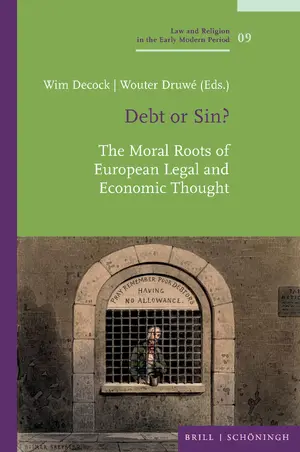
Brill has just published the book Debt or Sin? The Moral Roots of European Legal and Economic Thought, edited by Wim Decock and Wouter Druwé. The volume includes a contribution by dr. Maurits den Hollander titled ‘Debt and Insolvency in Early Modern Amsterdam: Religious Influences on the Desolate Boedelskamer?’.
In the seventeenth-century Dutch Republic, a debtor’s failure to pay was no longer necessarily seen as sinful behaviour deserving punishment. The main concern of early modern Dutch regents, in both their civil and religious capacities – i.e. as judges and Protestant elders – was to protect the interests and integrity of the urban community as a whole. Theologians such as Godfried Udemans and political thinkers such as Pieter de la Court distinguished honest insolvents from fraudulent bankrupts, arguing that those in financial trouble should be supported by the city’s legal authorities and be given the opportunity to rebuild their businesses.
Den Hollander’s contribution explores how these changing moral perspectives found practical expression in Amsterdam’s religious communities and its specialised insolvency court: the Desolate Boedelskamer.
The chapter as well as the volume’s other contributions can be found here: [link].

dr. Maurits den Hollander
Author