
On 24 September 2026, dr. Maurits den Hollander organised a seminar titled ‘The City as Space. ‘Spatializing’ History and Future of Urban Law and Governance?’ at Tilburg Law School. Dr. Marco in ‘t Veld and prof. dr. Dave De ruysscher were also among the speakers. Together with specialists of law and public governance, we reflected on the ‘spatial turn’ and what it means for our research.
At first, one might associate this with research utilising spatial digital tools, such as GIS, in its analysis. However, thinking in terms of ‘space’ goes much further than such geo-graphic representations of physical or cartographic space. Space in and around Dutch cities is scarce and has been for quite some time. Henri Lefebvre’s questioning who and what has a claim to urban space, has inspired a critical literature on the city as space and on urban spatial inequalities.[1] His work sparked an important change in perception, from ‘a focus on the city as a spatial entity to a focus on a spatial dynamic through fragmented, contested urban space’.[2] Edward Soja draws attention to the ‘socio-spatial dialectic’. As he argues, ‘the spatial shapes the social as much as the social shapes the spatial’. Especially relevant for us are the consequent spatial dimensions of justice and injustice, which are embedded in and constrained by spaces ranging from the body to the city to the entire globe, governed by plural normative orders.[3] As part of the GLG-theme ‘Urban Constitutionalism and Governance’, we asked ourselves what the city as ‘space’ means for us, considering both these larger debates and our own research. The ‘spatial turn’ debates tie in with the focus points of our research theme: who owns the city and what makes the city?
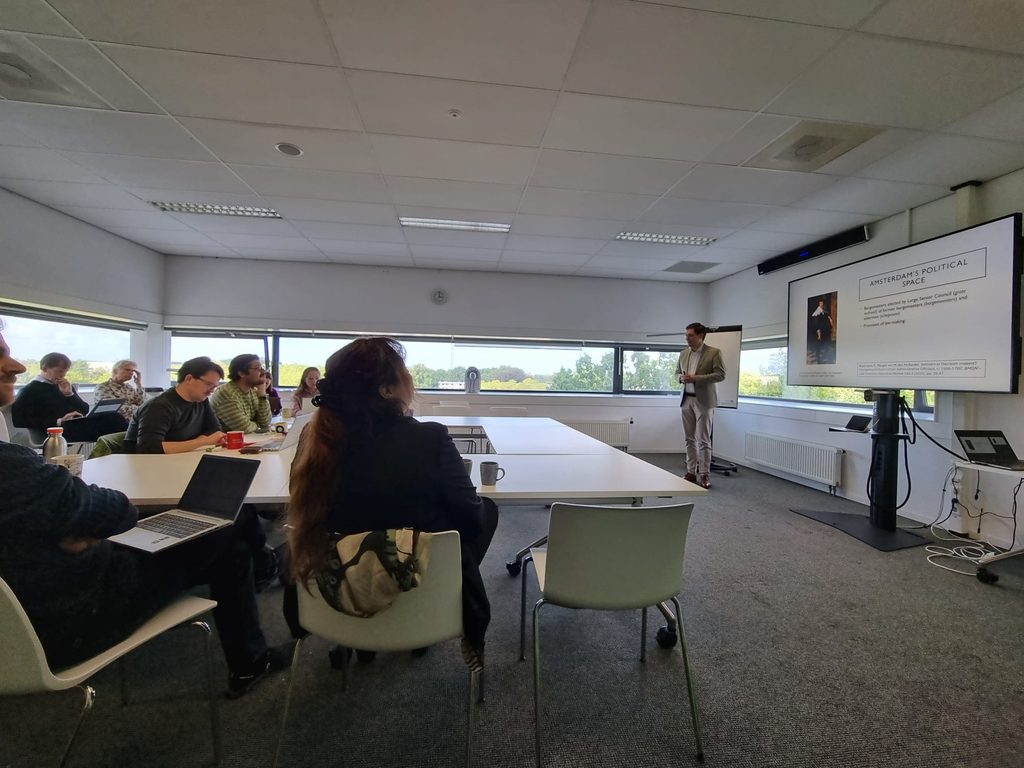
Session ‘The City as Political Space’ (photo: dr. Marco in ‘t Veld).
The spatial turn literature proved to be a fruitful starting point for discussion, ranging from bats and other non-human inhabitants of cities, to questions about water quality, economic sovereignty, cities as ‘sanctuary’ for refugees, ‘fair share’ spatial policies, the ‘new brutalism’ in local politics, and processes of law-making from below. The full program can be found here.
[1] Henri Lefebvre, ‘Le Droit à la Ville’, in: L’Homme et la société 6-1 (1967), pp. 29-35’; ibid., La Production de l’espace (Anthropos, 1974).
[2] Richard Rodger and Susanne Rau, ‘Thinking spatially: new horizons for urban history’, in: Urban History 47-3 (2020), pp. 372-383.
[3] Edward W. Soja, trans. Sophie Didier and Frédéric Dufaux, ‘La ville et la justice spatiale / The city and spatial justice’, in: Justice Spatiale/Spatial Justice 1 (2009), <https://www.jssj.org/article/la-ville-et-la-justice-spatiale/>; ibid., Seeking Spatial Justice (University of Minnesota Press, 2010).
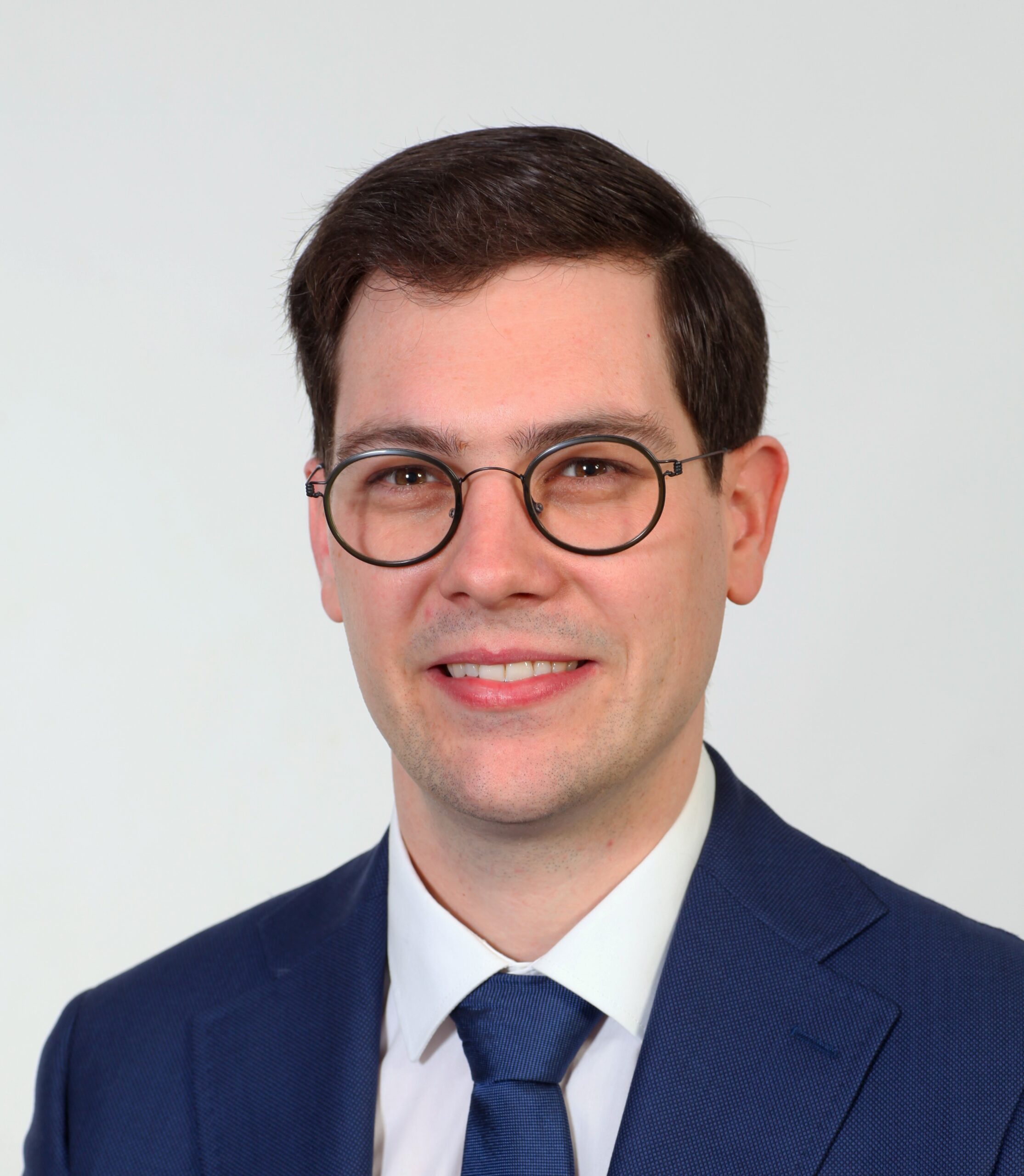
dr. Maurits den Hollander
Author